
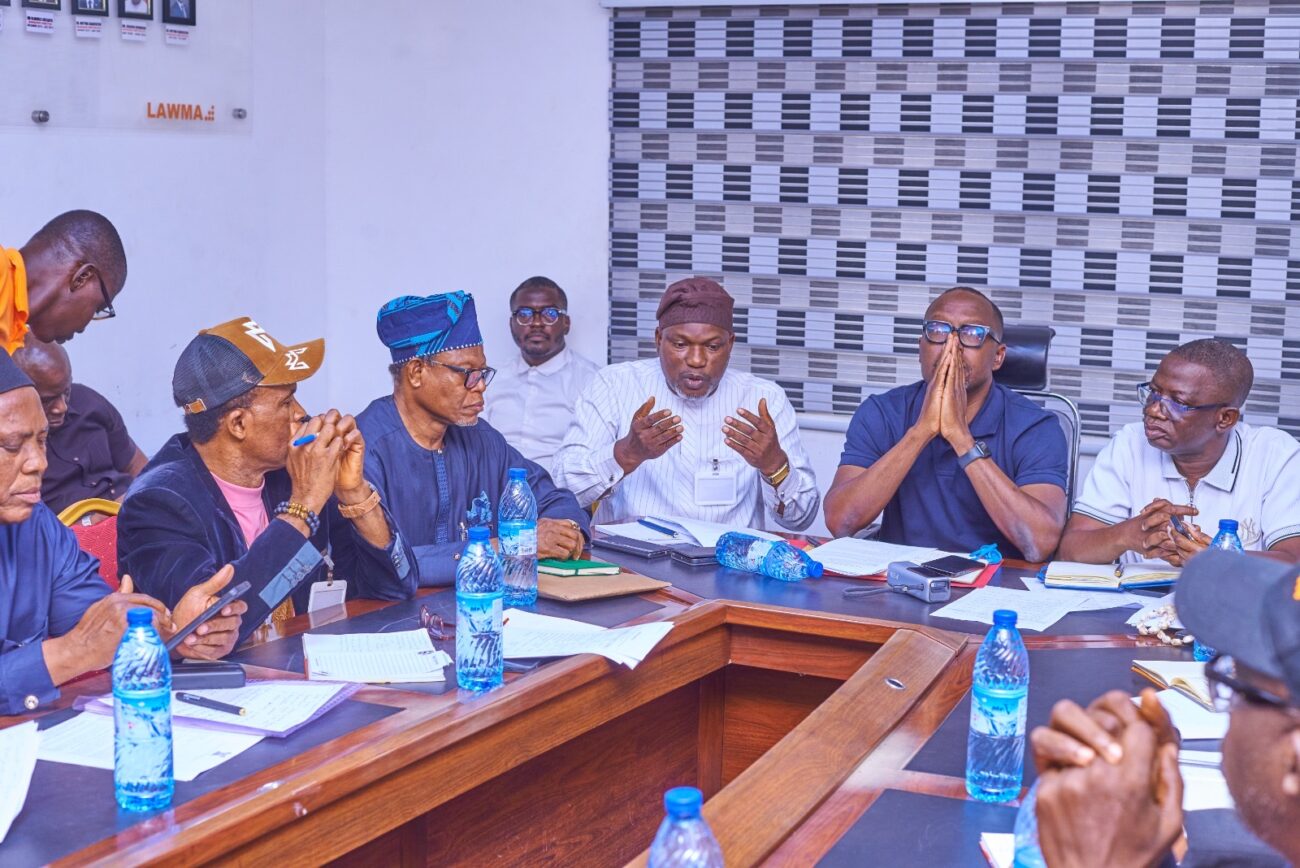
… Promises Legislation on waste sorting from State Assembly next month
Lagos’ struggle to keep pace with the mountains of waste generated daily across its communities has exposed the growing pressure on the state’s waste management infrastructure, with the Lagos Waste Management Authority (LAWMA) putting daily waste generation at between 13,000 and 16,000 tonnes.
The figure, disclosed by the Managing Director of LAWMA, Dr Muyiwa Gbadegesin, during a media briefing on the state of waste management in Lagos, underscores the scale of the challenge facing Africa’s most populous city, where an estimated 24 million residents and rapid urbanisation continue to increase the volume of waste requiring collection, transportation, treatment and safe disposal.
He further stated that the State House of Assembly is working expeditiously to come out with a Legislation that will make it compulsory for residents to sort their waste before disposal, noting that this will help in the State’s quest for modern and effective waste management.
The LAWMA boss said waste management demanded sustained investment in infrastructure, improved logistics, effective enforcement and greater cooperation from residents.
He said recent waste management challenges across the state had been aggravated by heavy rainfall, flooding and difficulties accessing major disposal facilities.
“Usually, as every rainy season, we tend to have some challenges. However, this year was much worse, and we can’t deny that,” he said.
According to him, the state’s major dumpsite had also been experiencing capacity constraints as it approached the end of its operational life. Flooding on access roads and disposal platforms further disrupted the movement of waste collection trucks, slowing down operations.
In response, LAWMA embarked on engineering interventions, including the rehabilitation of Road E, a secondary access road to the dumpsite, and the construction of additional disposal platforms.
The intervention, he said, was supported by Zoomlion Nigeria, a private-sector partner involved in the development of new waste management infrastructure.
The reopening of Road E and the provision of additional disposal platforms, he said, had improved logistics and reduced the turnaround time for waste collection trucks.
He disclosed that truck trips to the disposal facility increased from 1,394 to 1,781 during the period under review, while average daily trips rose to about 305 from the earlier figure of 278.
But even with the improvement, the scale of waste generation means Lagos requires far more infrastructure and collection capacity to keep pace with the waste produced every day.
The LAWMA MD said the state was developing two major transfer loading stations and material recovery facilities as part of efforts to move Lagos away from its traditional dependence on landfills.
One of the proposed transfer stations, he explained, would be capable of receiving about 2,500 tonnes of waste daily in a controlled indoor environment before the waste is transferred into long-distance trailers for onward transportation.
The facilities, he said, would reduce residents’ exposure to waste while improving the efficiency of transportation.
LAWMA is also working on material recovery facilities covering about 50 hectares each, where collected waste would be mechanically separated into organic materials, plastics, metals and textiles.
The organic component, which the MD said could account for about half of the waste stream, would be converted into compost for farmers and gardeners, while recovered plastics could be processed into waste bins for distribution to residents.
The authority is also trying to close gaps in household waste collection.
The MD said the state had received 10 additional trucks from the Lagos State Lottery Fund, with six already deployed for direct house-to-house collection in parts of Mushin where there were no functioning Private Sector Participation (PSP) operators.
He described the arrangement as an interim measure pending the appointment of new PSP operators in underserved communities.
“We do not want residents bringing their waste to the median. It is better for us to engage with your Community Development Associations and estates where we don’t have PSP operators so that we can come in and do direct collection as much as we can,” he said.
The authority is also expecting 150 additional compacted waste trucks before the end of the year.
According to the LAWMA boss, 114 trucks had been ordered by local governments and municipalities, while the state government had ordered another 36.
Despite the planned additions, however, he said Lagos still needed considerably more collection vehicles.
The state’s analysis, he said, indicated that about 2,000 compacted trucks would be required to provide adequate coverage, making further investment in waste collection infrastructure necessary.
But the challenge is not simply the number of trucks.
In densely populated communities and areas with narrow roads, large waste trucks often struggle to reach households and businesses.
To address this, LAWMA is introducing smaller tricycle waste collection vehicles with capacities ranging from 500 kilogrammes to one tonne.
The MD said the model had been piloted and would be expanded to other communities where conventional waste trucks could not operate efficiently.
The tricycles would collect waste from homes and businesses and transport it to designated transfer points, from where compacted trucks would move the waste to disposal or processing facilities.
Beyond improving collection, the model, he said, would create employment and business opportunities and bring more operators into the formal waste management value chain.
LAWMA is also reviewing the PSP scheme, which has operated in its current form for about two decades.
The MD said the review would take into account population density, topography, waste generation and the cost of servicing individual local government areas rather than applying a uniform model across Lagos.
The authority, he said, was working with waste managers and other stakeholders through six working groups to develop recommendations for a restructured PSP programme.
He stressed that waste management should be treated as a business rather than an entitlement, although government would have to subsidise services in low-income communities where residents might not be able to afford the full cost of collection.
Enforcement is another major component of the authority’s strategy.
The LAWMA boss said the authority had strengthened its operations in collaboration with the Lagos State Environmental Sanitation Corps, Rapid Response Squad, Environmental Task Force and other agencies.
He warned that the state maintained a zero-tolerance policy towards indiscriminate waste disposal, adding that offenders would face arrest and prosecution.
However, he said enforcement alone would not solve the problem.
The authority is also expanding public education through advocacy teams visiting markets, estates and communities to promote responsible waste disposal.
LAWMA’s academy and internship programmes are equally being used to educate young people about waste management and encourage them to see waste as an economic resource rather than merely refuse.
The authority’s long-term vision, the MD said, was to transform Lagos from a linear waste management system into a circular economy in which waste would be sorted at source and converted into useful resources through recycling, composting, material recovery, waste-to-energy projects and biogas production.
“We must have the capacity to collect, transport, treat and safely dispose of waste,” he said.
He stressed that achieving a cleaner and more sustainable Lagos would require a com.bination of government investment, private-sector participation and active cooperation from residents.
He appealed to Lagosians to support the state’s waste management initiatives by patronising approved operators, complying with environmental regulations and refraining from indiscriminate disposal.
With Lagos generating as much as 16,000 tonnes of waste every day, the challenge is no longer simply about removing refuse from streets and neighbourhoods. It is increasingly about building a waste management system capable of matching the scale and speed of the city’s growth.
The LAWMA boss said the authority remained committed to working with the media, private sector and communities to confront the challenge and build a cleaner, healthier and more sustainable Lagos.