
…As LAWMA engage communities for smooth transition
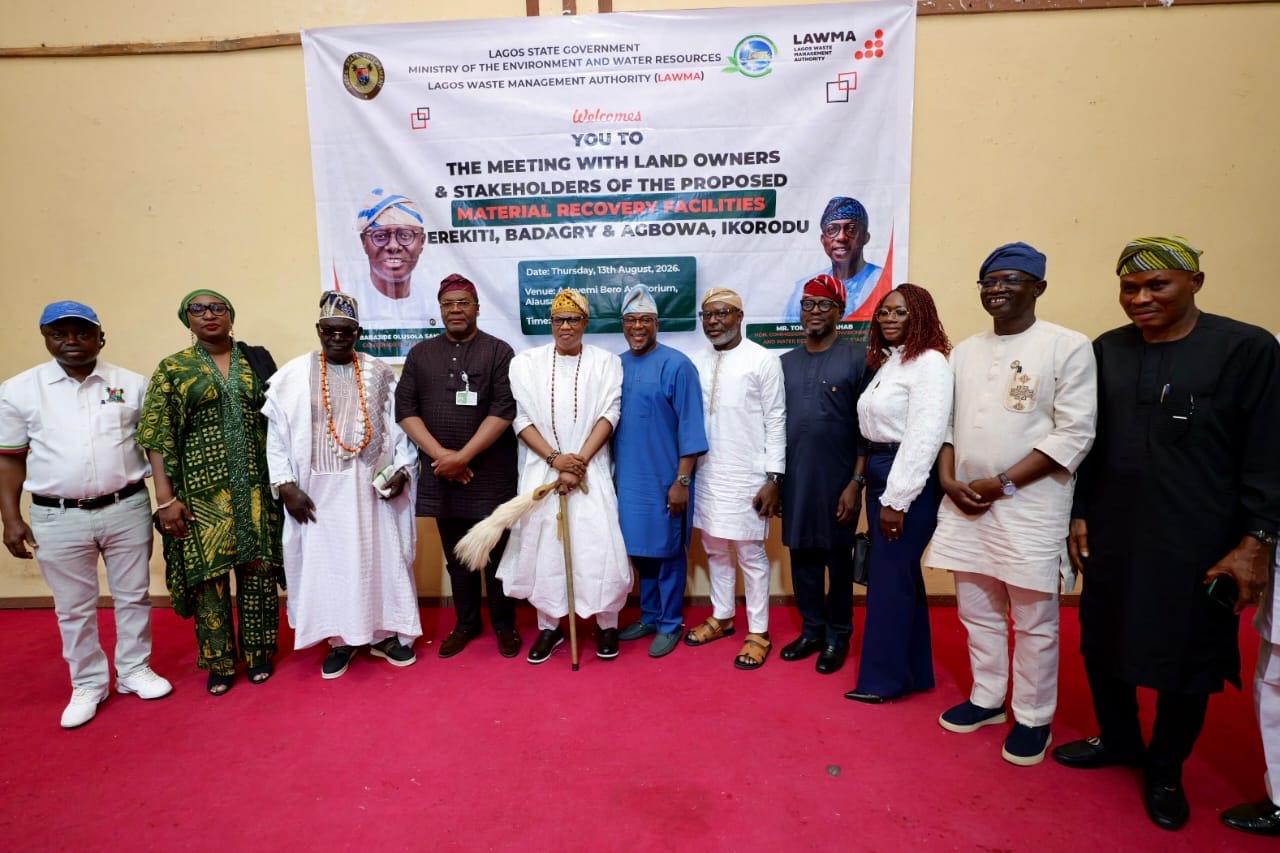
The Lagos State Government has commenced engagement with landowners, traditional rulers and other stakeholders over plans to construct Material Recovery Facilities (MRFs) at Erekiti in Badagry and Agbowa in Ikorodu.
Permanent Secretary, Mr. Mobolaji Gaji, Office of Drainage Services, disclosed this at a stakeholders’ meeting held on Thursday at Alausa, Lagos.
Gaji said the proposed facilities formed part of the state’s waste management improvement programme aimed at transitioning Lagos from a linear waste disposal system to a circular economy.
He said the project was designed to treat waste as a resource capable of generating employment, wealth and environmental benefits, rather than merely disposing of it in landfills.
According to him, Lagos generates more than 13,000 tonnes of municipal waste daily, making improved waste recovery and management critical to the state’s environmental sustainability.
He said the MRFs would receive, sort and recover recyclable materials, including plastics, metals, paper and organic waste for reuse and further processing.
Gaji said the project was aligned with the health and environment pillar of the THEMES Plus agenda of Gov. Babajide Sanwo-Olu’s administration.
He stressed that the project was not merely about constructing infrastructure but about establishing a sustainable waste-management value chain capable of reducing dependence on landfills and mitigating greenhouse gas emissions.
The permanent secretary said the host communities would be primary beneficiaries of the project through employment, skills acquisition, improved sanitation and other social interventions.
He said access roads and other infrastructure would also be provided, while the government would work with communities to ensure their welfare was protected.
“We are here to listen to you and ensure your welfare is well protected,” he said.
Gaji appealed to traditional rulers, Baales, community associations and youth leaders to become ambassadors of the project by sensitising their people.
He assured stakeholders that the proposed facilities would not be conventional dump sites but enclosed and environmentally controlled facilities built to appropriate standards.
“There is no need for apprehension. These facilities are not dump sites,” he said.
He said the state would establish stakeholder representation and a grievance-redress mechanism to ensure that concerns were addressed transparently and promptly.
Gaji urged stakeholders to approach the engagement with an open and constructive mind, describing the project as a collective initiative involving government and host communities.
Also speaking, Dr. Muyiwa Gbadegesin Managing Director, Lagos Waste Management Authority (LAWMA), said the project was expected to generate about 5,000 direct and indirect jobs across the two locations.
Gbajabiamila said local residents, particularly youths and women, would have opportunities in plant operations, equipment maintenance, environmental monitoring, administration, security, cleaning and materials handling.
He said the project would also provide structured technical training, apprenticeships and certification linked to actual workforce requirements.
According to him, competent local firms will have access to appropriate supply and service opportunities, subject to applicable rules.
He said the facilities would stimulate economic activities in recycling, compost production, equipment servicing, logistics, materials aggregation and other areas.
Gbadegesin said the project would also facilitate infrastructure development, including access roads, drainage, power, water, communications and security.
He assured stakeholders that the government would implement environmental and social safeguards to ensure that the project did not transfer environmental problems or nuisance to host communities.
“The project is not intended to relocate environmental problems or nuisance to your community. We will not do that,” he said.
He listed the safeguards to include suitable buffers, controlled access, storm-water separation, leachate management, fire protection and safe traffic circulation.
He said open burning, uncontrolled dumping, discharge of waste into surrounding land or water and unsafe waste picking would not be tolerated.
Gbadegesin added that truck routes would be controlled and communicated to the communities.
He said a community liaison committee would be established, comprising representatives of landowning families, traditional and community leaders, youths, women and relevant local governments.
The committee, he said, would receive regular project updates, review community impacts, track agreed commitments and operate an accessible grievance-resolution mechanism.
In his presentation, Mr. Francis Akoto an engineer representing Zoomlion Nigeria Ltd., said the project was aimed at helping Lagos move away from indiscriminate dumping towards resource recovery and a circular economy.
He said Lagos generated between 13,000 and 15,000 tonnes of waste daily, stressing that the existing disposal system was under pressure.
According to him, the proposed system will ensure that waste is sorted and recovered, with organic materials converted into compost while plastics and metals are recycled.
He said the proposed facilities would include a Material Recovery Facility and a Transfer Loading Station, each with a processing capacity of about 2,400 tonnes per day.
Francis explained that waste arriving at the transfer station would be weighed and recorded before being compacted into sealed containers for onward transportation to the processing facility.
He said the facilities would be fully enclosed, with odour extraction systems and daily washing of floors to maintain hygienic conditions.
The arrangement, he said, would reduce roadside truck queues, odour, flies, rodents and mosquitoes associated with uncontrolled waste disposal.
He added that improved waste management would also contribute to cleaner drains and reduce flooding caused by indiscriminate dumping of waste into drainage channels.
Akoto said existing dumps could eventually be reclaimed and repurposed for other beneficial uses as the state transitions towards a circular economy.
On employment, he said the project would create opportunities for skilled, semi-skilled and unskilled workers, with priority given to youths and women in host communities.
He said waste pickers would also be integrated into the formal waste-management system through training, protective equipment, safety measures and paid employment.
According to him, the circular economy would stimulate businesses in transportation, security, catering, artisan services and materials aggregation.
He projected that more than 1.1 million bags of organic compost could be produced annually from the facilities, while recovered plastics and metals would create a market for recyclable materials.
Akoto said Zoomlion would also establish a community liaison structure, conduct quarterly reviews and provide formal channels for grievances.
He urged stakeholders to support the project, nominate representatives to the liaison committee and encourage youths in their communities to participate in planned training programmes.
Also speaking, Zoomlion’s Managing Director, Mrs. Habiba Abubakar, said the company would provide stakeholders with an opportunity to physically inspect its existing facilities instead of relying solely on videos and presentations.
She said five representatives each from Ikorodu and Badagry would be selected to visit operational facilities and observe their activities firsthand.
“We don’t just talk, we do,” Abubakar said, assuring stakeholders that the inspection would enable them to see the company’s waste-management operations directly.
She said the visits would help stakeholders better understand the proposed facilities and address concerns about their operations.
The meeting also provided an opportunity for the government and project proponents to seek the cooperation of landowners and host communities to facilitate access to the designated sites.
Gaji said the government was committed to ensuring that no community was left behind or shortchanged in the implementation of the project.
He urged stakeholders to support the initiative, saying the success of the facilities would depend on cooperation between the government, project developers, traditional institutions, landowners and residents.
The engagement was attended by traditional rulers, community leaders, representatives of landowners, local government officials, officials of the Lands Bureau, Ministry of Environment and Water Resources, LAWMA and other relevant government establishments.