
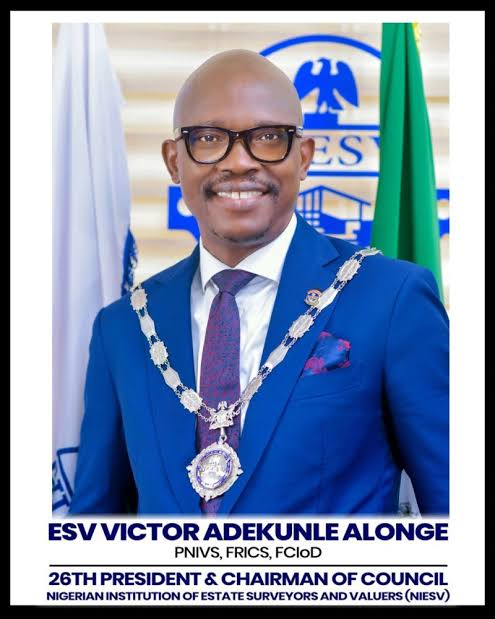
Victor Alonge, President, Nigerian Institution of Estate Surveyors and Valuers (NIESV), is a seasoned real estate professional with extensive international experience. In this interview with Assistant Editor, Okwy Iroegbu-Chikezie, Alonge speaks on the issue of housing affordability has remain a contentious one, access to mortgage, affordable housing, national economic reforms, land management and his activities as the NIESV president among others
The issue of housing affordability—whether for home ownership or rental—is fundamentally an economic one, driven by the forces of demand and supply. These forces are, in turn, shaped by the level of production within the housing sector. It is important to recognise that the cost of accommodation often reflects the broader price environment in the economy.
Where housing supply falls short of demand, prices—both for rent and purchase—will inevitably rise. This is the reality we are currently experiencing. Addressing this challenge, however, requires more than a single, one-size-fits-all solution. It calls for a comprehensive and coordinated approach.
A critical starting point is the development and strict implementation of a well-articulated national housing policy. Such a policy should serve as a guiding framework for all stakeholders, covering the entire housing value chain—from research and design to construction, financing, and delivery. It must address key areas such as development finance, mortgage accessibility, affordability, and the provision of social housing.
Equally important are reforms in land administration, including improving access to land, simplifying titling processes, and ensuring transparency in documentation. When these structural issues are addressed in a coherent and sustained manner, the housing market will become more efficient, mortgage systems will deepen, and rental costs will gradually become more affordable for the average Nigerian.
How about the impact of high rental costs?
Government intervention in rising rental costs will remain ineffective if it does not address the root causes of the problem. Efforts by some states to impose rent control through edicts have consistently failed and are unlikely to succeed, largely because it is difficult to regulate assets that the government does not own or directly supply.
The more sustainable approach lies in boosting housing production. Rather than engaging in direct construction, the government should focus on creating an enabling environment that encourages private sector participation. This includes providing incentives, improving access to finance, streamlining land administration, and ensuring regulatory clarity.
Experience from developed economies, particularly across Europe, shows that housing challenges are better managed where governments act as facilitators rather than primary developers. By promoting increased supply through private investment within a well-regulated framework, Nigeria can begin to address the persistent imbalance between housing demand and availability, which ultimately drives high rental costs.
How far has the Renewed Hope Agenda of the government gone in addressing Nigeria’s housing needs?
The Renewed Hope Agenda is, without doubt, a commendable and forward-looking initiative. However, beyond its vision, there is a pressing need to ensure that the programme is thoroughly thought through and strengthened to achieve lasting impact. At present, it appears largely as an initiative of the current administration, and that raises concerns about continuity.
What is required now is deliberate institutionalisation. The housing agenda must evolve into a national policy framework that transcends any single government. This will ensure that successive administrations not only sustain it but also build upon it as a structured and enduring solution to Nigeria’s housing challenges.