
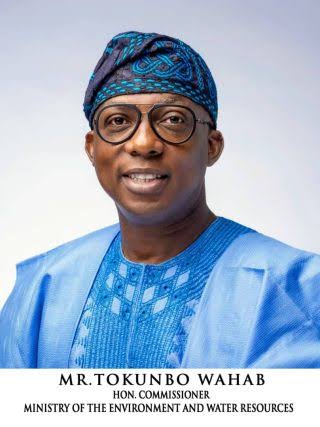
The Lagos State Government is collaborating with the World Bank to enhance emergency and risk management in the state.
The Commissioner for Environment and Water Resources, Mr. Tokunbo Wahab made this known during a strategic business meeting with a team on Nigeria Disaster Risk Management from the World Bank. He said the collaboration underscores the government’s commitment to building resilience and reducing vulnerability to disasters and risks.
According to him, Lagos State Government is continually taking concrete steps to put infrastructures in place; both physical infrastructure and human resource with the hindsight that Lagos is a coastal state prone to flash flooding, it did not create the geography that situated Lagos where it is today, and that explains its reality.
He said the state is bounded in the south by four hundred and eighty-six kilometers of the Atlantic and about twenty-five percent of Lagos land is water, saying these are natural realities that expose the state to flash flooding.
He said at the beginning of every year, the government usually sends out early warning signals regarding some risk issues in the state adding that these warning signs help the state flag ahead of time the issue of sea level rise, and communicate to the neighboring communities that may be affected.
He said later this month, with respect to the NIMET’s rainfall forecast, the government will communicate the early warning signs to the residents.
Wahab said in the past couple of years what the ministry had also done differently is not just to ramp up those infrastructure but to also ensure the continuous cleaning ,dredging of the primary, Secondary, Tertiary and manholes across the state all year round.
He explained that there are also incidents where human elements interfere with nature’s ecosystem, for instance where “people choose to build on the floodplain or choose to destroy the mangrove, knowing that these are nature’s protective gears against flooding or flash flooding.
He said as a result of these bad behaviours, the government decided to enforce its laws to restore order, saying that realistically, Lagos can’t run away from flooding being a coastal state.
He added that science has clearly proven that when it rains heavily, there will be a tidal lock and when the tidal lock happens, storm water cannot discharge no matter the resilience infrastructure the state has in place nor the early warning signs that had been put in place.
He added that the state chose to ban single-use plastics some time ago even when some countries in Europe had not banned it but Lagos had to do it because of state peculiarities saying the state is willing, ready and open to work with the World Bank.
“Today, we are thankful for the decision on Styrofoam and the Single Use plastics ban. As a state, we are already transitioning from the linear waste system because as a state we know we generate about 13,000 tons of municipal solid waste a day. Some countries in Europe don’t even do that in a week” he said.
He stressed that the State took the decisions to find a way to make waste a resource, either for wealth or for energy saying the government is thinking outside the box by turning the challenges around and seeing the positives in those things.
Earlier, the team Lead and Senior Disaster Management Specialist, World Bank, Mr. Francis Nkonka said part of the engagement of World Bank is on emergency preparedness and response adding that World Bank seeks to understand the gaps and challenges in Lagos State.
He said they are set to effectively align with the state through technical and investment support from the World Bank on risk Management.
He said the team had earlier visited Agencies of Government in the fire and rescue unit, where their needs in terms of facilities, equipment, personnel information systems, data collection amongst other were highlighted, adding that the World Bank wishes to support Lagos State to be a beacon of best practices for other states in the Country.
Also, Economy Planning and Budget Commissioner, Mr. Mosope George expressed appreciation to the World Bank for the partnership saying the partnership is expected to bring together experts from both organizations to identify areas of high risk and develop strategies to mitigate them.
He added that the initiative would involve the development of early warning systems, emergency response plans, and public awareness campaigns to educate residents on disaster risk reduction and management.