
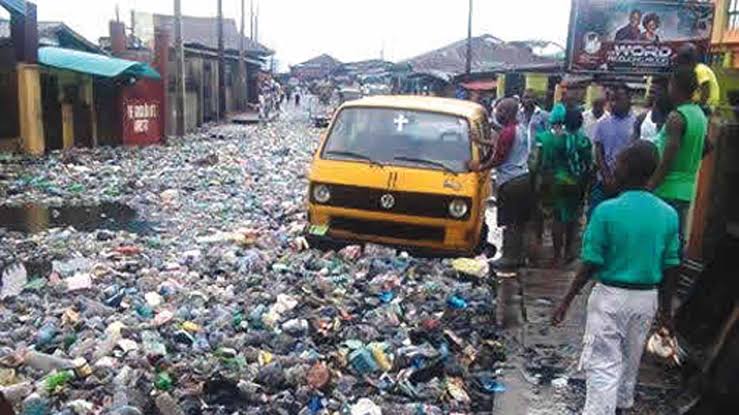
The Lagos State Government has urged residents to prepare for heavy rainfall and refrain from dumping waste in drains, warning that such practices could worsen flooding during the rainy season.
The Commissioner for the Environment and Water Resources, Mr. Tokunbo Wahab, disclosed this during a press briefing on seasonal climate predictions and social-economic implications for the state
The forecast, released by the Nigerian Meteorological Agency (NiMet) on February 10, predicts an early onset of rains, above-normal rainfall in parts of the country, and higher-than-normal temperatures during the early months of the year.
Wahab explained that the prediction is based on a projected weak La Niñacondition and a neutral phase of the El Niño Southern Oscillation (ENSO), which are global climate patterns that influence rainfall and temperature.
According to the forecast, the rainy season in Lagos is expected to start in the last week of March and end in the first week of December.
“The prediction implies an early onset of the rainy season, a longer-than-normal duration and a delayed end of the rainy season in Lagos
“As a result, above-normal rainfall amounts are anticipated during the first peak of the rainy season,” Wahab said.
The average annual rainfall across the state is projected to range between 1,650mm and 3,030mm, with an overall average of 1,965mm across the 20 Local Government Areas.
NiMet’s projections indicate that Ikeja will likely record rainfall starting on March 3 and ending around December 2, with about 1,932mm of rain expected. Badagry is predicted to experience rainfall from March 28 to December 3, with approximately 2,010mm, while Ikorodu may receive about 1,935mm within a similar timeframe.
In Lagos Island, rainfall is expected to begin on March 30 and end on December 2, totaling around 1,968mm, while Epe may record about 1,984mm between March 29 and December 3.
The commissioner warned that the high rainfall amounts could lead to flooding in some areas, especially in low-lying communities, while strong winds expected during the beginning and end of the rainy season could pose risks to lives and property.
He noted that disruptions to commercial activities, flight delays and revenue losses could occur during periods of severe weather.
To mitigate the risks, the state government said it has intensified flood control measures, including year-round drainage maintenance and improved waste management.
Wahab said the government is also working closely with the Ogun-Oshun River Basin Development Authority to monitor and regulate water releases from the Oyan Dam to prevent flooding along the Ogun River basin.
Low-lying communities such as Agiliti, Agboyi, Itowolo and Ajegunle are being closely monitored because of their vulnerability to river flooding.
The state has also placed the Lagos State Signage and Advertisement Agency on alert to ensure compliance with safety regulations for billboards and telecommunications masts, which could be affected by high wind speeds during storms.
Emergency response agencies and traffic management authorities have also been directed to remain on high alert to respond quickly to weather-related incidents.
Wahab urged residents living in flood-prone areas such as Owode, Iwaya, Makoko, Badia, Ijora, Isaalu, Pota and Shibiri to remain vigilant and be prepared to relocate to safer areas if necessary.
He also appealed to the media to avoid sensational reporting during rainfall events, explaining that temporary flash floods that drain quickly are common in many cities.
“Flooding should only be reported when water remains on the roads for hours,” he said.
The commissioner called on Lagosians to support government efforts by clearing drains around their homes and reporting drainage blockages to resident engineers stationed across the state’s 57 Local Government Areas and Local Council Development Areas.
He added that the state has strengthened its Flood Early Warning Systems (FEWS) to provide timely alerts and help reduce the impact of heavy rainfall during the 2026 rainy season.